Monday, August 19, 2013

Science Vs. Religion

I've decided that instead of jumping back into my series on the Doctrines of Grace, I'm going to be making a post or two about more general Christian issues and maybe Creationism. You know, to add a little variety, since I've been harping solely on Calvinism for the last ten posts or so. I hate postponing it farther than it already has been, but I figured you guys are kind of getting tired Reformed posts.

Anyway, in this post I'll be tackling a common argument (usually used in defense of the theory of Evolution) that I've seen in a lot of places, primarily online. The topic? Science Vs. Religion.

It's a trap!
The first thing you need to realize when someone starts talking about "Science vs. Religion" is that basically, it's a trap. Don't fall for it. I did in several debates, and it made things a lot harder for me.

So how is it a trap? It's simple. By agreeing to debate "Science Vs. Religion," you basically put yourself in a position where you have to defend all religions, as whole. Which is impossible, and not something a Christian should be doing anyway.

Richard Dawkins takes advantage of this trick in his book The God Delusion.
"... To forestall an inevitable retort to the book, one that would otherwise -- as sure as night follows day -- turn up in a review: 'The God that Dawkins doesn't believe in is a God that I don't believe in either'... I am not attacking any particular version of God or gods. I am attacking God, all gods, anything and everything supernatural, wherever and whenever they have been or will be invented"
In essence, you'd have to defend all gods (and the religions built upon them) to reply to Dawkins.
By letting him (or whoever) decree the terms of the debate, you allow yourself to be put in an indefensible position. Unless you're up against an incompetent opponent (which, when I fell for this trap, I was), then you will lose such a debate. The key is to redefine the debate so that you're not defending all religions, but rather, just Christianity.

Faith Vs. Facts
Usually the people pushing this argument will point out that, among other numerous differences, Science is built on facts while Religion is built on (usually blind) faith.

Again, the first thing to do is to redefine the terms of the debate so that you're defending just Christianity. Because in reality, some if not most other religions are built solely on blind faith, with no factual backing... Unlike Christianity.

Christianity is actually built upon lots of facts. Archeology, time and time again, has affirmed the Bible. I won't go over any examples, since you should already know them (though I will probably go over them in future posts, eventually).

Science, on the other hand, relies heavily on faith. Evolution has never been witnessed, all we can do is look at the fossil record and other sources and have faith that all living organisms evolved from a common ancestor. This is the case with all theories: we look at the evidence, and then come to a conclusion based on it. We're not 100% sure that our conclusion is a correct one, but we have faith that it is.

So in reality, Science and Christianity both deal with facts, and both require faith.

So What?
People claiming "Science Vs. Religion" in the Evolution/Creation debate will often do their best to point out all the differences between science and religion. The previous point (faith vs. facts) is a example of this.

But so what if science and religion are different? Math and history are different too, but does that mean we should keep one and do away with the other? Of course not! Both are important. And in the case of science and religion, we can have both.

Now, I'm not saying we should combine science and religion, any more than I think we should combine math and history into one subject. But they should be and are connected, just like math and history. Where would history, with all its important dates and figures, be without math? Similar to how math and history work together, science and religion (should) work together. If scientific evidence points to the existence of a God (which I believe it does), we shouldn't dismiss such evidence as being outside of the realm of science and inside the realm of religion. The two work together, and flow into each other.

In any case, just because science and religion are different, doesn't mean we should discard one of the two. Which brings us to the main problem of the "Science vs. Religion" topic.

Logically Fallacious
Why am I suddenly craving Lucky Charms? Never mind.
The main problem with "Science vs. Religion" is that it's a logical fallacy. Specifically, the "false dilemma" AKA "either-or" fallacy, which fools us into thinking that we have to choose between (usually) two things. When in reality, there may be more options to choose from, including "neither" or "both." And, as mentioned above, my position is that we can have both. In fact, we do have both (or at least, I and many others do).

"Science vs. Religion" is a fallacy. We don't have to choose one or the other: we can have both.

So that's the problem with "Science vs. Religion." It's a tricky argument meant to trap believers, and it's logically unsound to boot.

But that's not the end of the story! All we've done is defended from the attack. You can, if you want to, switch from defensive to offensive mode and turn the tables on your opponent. That's what we'll be doing in the next few points.

Who's the Bad Guy Here?
This first one also comes in handy when going up against the "Religion is violent because the Crusades/Inquisition/HitlerWasAChristian" argument.
Vox Day uses this argument in his book The Irrational Atheist:
"The five major religions of the world…have approximately 4.85 billion adherents, representing an estimated 71.3 percent of the world’s population in 2007, and they have been around for a collective 11,600 years. During the vast majority of those 116 centuries, the world has not been in any danger of extinction from weapons of any kind, nor has the human race been in serious danger of dying out from pollution, global warming, overpopulation, or anything else. Despite 116 centuries filled with hundreds, if not thousands, of diverse religions, all competing for mindshare, resources, and dominance, the species has not merely survived, it has thrived…In the last sixty years, science has provided a veritable witches’ brew of potential dangers to the human race, ranging from atom-shattering explosive devices to lethal genetic modifications, designer diseases, large quantities of radioactive waste…"
In essence: between science and religion, science (if anyone) is the bad guy. However, you need to be careful not to go off the deep end and become anti-science. Science and religion are both amoral. It's when bad people use them for immoral purposes that they become forces for evil ("Religion/Science doesn't kill people; people do!").

Where Would You Be Without Me?
One thing you can point out is that, believe it or not, modern-day science owes its existence to Christianity. Indeed, most of the great founders of science as we know it, such as Nicholas Copernicus, Sir Francis Bacon, Galileo, and Isaac Newton were Christians! Even Charles Darwin was a practicing Christian (though he later renounced his faith).

But that's not all. Dr. Melvin Calvin, a no-religious scientist and a winner of the Nobel Prize for his explanation of Calvin Cycle "dark reactions," says:
"The fundamental conviction that the universe is ordered is the first and strongest tenet [of science]. As I try to discern the origin of that conviction, I seem to find it in a basic notion discovered 2000 or 3000 years ago, and enunciated first in the Western world by the ancient Hebrews: namely that the universe is governed by a single God, and is not the product of the whims of many gods, each governing his own province according to his own laws. This monotheistic view seems to be the historical foundation of modern science"
As Nuclear Physicist and Creationist Dr. Jay L. Wile puts it:
"...early Christians understood that the world was created by a single God who is a Lawgiver, it made sense to them that the universe should run according to specific laws, and those laws should be the same everywhere in the universe. In addition, because they believed they had been given the image of God, they thought it was possible to understand those laws. That’s what prompted the revolution that produced science as we know it today."
So science owes religion. Big time!


So there you have it. "Science vs. Religion." Well, this post has gone on long enough! If you didn't already, you now have the proper tools to counter the "Science vs. Religion" fallacy.

Just remember: the purpose of a debate like this is not to "win" or to be right. You are not trying to destroy the other person. You are trying to convert them, to "give a defense to everyone who asks you a reason for the hope that is in you" (1 Peter 3:15), and to "speak the truth in love" (Ephesians 4:15). They are not our enemy.

Author's note: Jonny has never actually craved lucky Charms in his lifetime. Ever.

Monday, July 22, 2013

Double-Predestination: Does God Elect People to Hell?

This will (hopefully) be my last post before getting back into the "Speak up" and "What I believe" series which I left hanging.
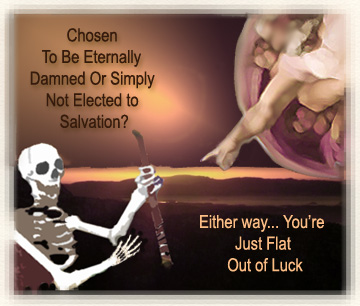
http://www.inplainsite.org/assets/images/Predestination.jpg
Believe it or not, the internet abounds with anti-Calvinist memes and pictures like this one
In this post I'll be talking about the notion of double-predestination: that God elects some people to heaven, and some people to hell. We'll specifically be looking at it from the point of view that it is an attack on Calvinism, since Calvinists are often charged with holding this view. Perhaps a later post will go over why the idea is unbiblical.

This objection has several problems in common with the claim that  "Calvinists believe that babies go to hell," which we went over in a previous post:

First of all, it is an emotional attack, meant to discredit rather than to disprove the Doctrines of Grace. It makes you go "Whoa, Calvinists believe that? I don't want to have anything to do with Calvinism!" Instead of pointing to scripture and saying "Here's how Calvinism is unbiblical, and therefore, wrong." This is a problem for those pushing this particular objection.

Secondly, it once again unfairly paints all Calvinists with the same brush. Yes, some Calvinists do believe in double-predestination (if I'm not mistaken, my old pastor in Florida is among them), but some don't (such as my family and many others). This is because...

Thirdly, the doctrine of double-predestination is NOT a specifically Calvinistic idea. Like last time, when we see a claim such as "X Calvinist believes X doctrine" we need to ask ourselves if X doctrine really comes from TULIP or from somewhere else. Double-predestination is not found in TULIP, though it can be made to fit with it.

Those are the three flaws that this argument shares with the last one (Calvinists hate babies), and I will not go into them in any more detail here since I already did there.

On to the argument itself. As is the case with many objections to Calvinism, the claim that Calvinism teaches double-predestination stems from misunderstanding. In this case, a misunderstanding of the Calvinistic Doctrine of Unconditional Election, as well as a misunderstanding of how God judges man.

The doctrine of Unconditional Election does not teach that God elects some people to hell and some people to heaven. UE deals specifically with God Electing people to Salvation, not Damnation.

But some would argue that God not electing people to heaven is basically the same as God electing those people to hell, and that on Judgement day, the condemned sinner cold use the excuse "But God, you didn't elect me!" But that's just not how it works.

God does not predestine people to hell. People destine themselves to hell by sinning. We had our chance in the garden, and we screwed up (Genesis 3). Adam's fall brought sin into the world, and all men, being descendants of Adam, are part of that sin (Romans 5:12). The wages of sin is death (romans 6:23), and thus, ALL men are condemned to Hell, not by any of God's doing, but by Adam's and by their own.

As for the "you didn't elect me" excuse, the reason it fails is that it misunderstands how judgement and atonement works. On Judgement day, God won't choose who goes to heaven and who goes to hell based on whether a person has been elected or not. Revelation 20:12-13 says:
"And I saw the dead, small and great, standing before God, and books were opened. And another book was opened, which is the Book of Life. And the dead were judged according to their works, by the things which were written in the books. The sea gave up the dead who were in it, and Death and Hades delivered up the dead who were in them. And they were judged, each one according to his works." (Emphasis mine)
It is our works by which we will be judged and condemned. And if that's the case, then we all deserve to go to hell because we're all sinners. This is where election comes in. I like the way the Baptist Catechism puts it:
Question 24: Did God leave all mankind to perish in the condition of sin and misery?

Answer: God, out of his mere good pleasure, from all eternity, having chosen a people to everlasting life, did enter into a covenant of grace, to deliver them out of the condition of sin and misery, and to bring them into a condition of salvation, by a Redeemer. (Ephesians 1:3-4; 2 Thessalonians 2:13; Romans 5:21; 8:29-30; 9:11-12; 11:5-7; Acts 13:48; Jeremiah 31:33)
So let's look at that non-elect sinner's excuse in light of what we know about judgment day. Yes, it is true that God didn't elect the person, but they couldn't use that as an excuse to get out of the punishment of hell. Why? Because they sinned, and the wages of sin is death.

As for the elect person, he has sinned too, and so is condemned to hell as well... BUT! "Moreover whom He predestined, these He also called; whom He called, these He also justified..." Because Jesus took their sin and punishment upon Himself, the elect man has been Justified.
"...and whom He justified, these He also glorified." (Romans 8:30, emphasis mine) Such will be the case for all of God's elect on Judgement day, and I hope by His Grace that you are among them, dear reader.

Tuesday, July 9, 2013

Calvinists Hate Babies?

http://cdn.memegenerator.net/instances/400x/33433764.jpg
I can't believe this meme even exists.
Ahhh, now that I've graduated, I have more time to spend blogging. This means that all of my blogs (which have gotten a little stale) will enjoy constant updates from now on.

One thing that I've read recently about blogging (and writing in general) is that if you don't know what to write about, find something that you're passionate about, that you get worked up over, and write about that.  So before I jump back into the numerous blog series I've left hanging (this and this), that's what I'll be doing. Posting about things that, for lack of a better expression, get my blood up.

Most will probably have to do with objections to Calvinism. I usually don't get emotional or worked up about most arguments, but some of the "arguments" against Calvinism are just so outrageous (like Irresistible Grace being "spiritual Rape"), that I think you'll understand my position.

So today I'd like to dive into one of the more emotionally-charged claims that is often leveled at the proponents of the Doctrines of Grace.

Here it is: "Calvinists believe that babies go to hell" Just hearing it makes me angry. However, I'll do my best not to let my emotions take control. Speaking of emotions, this argument is what's called an emotional attack, which, if you didn't know, is a fallacy (a mistake in logic or thinking).
The argument fails to disprove any one of the five points of Calvinism, but rather, it serves to discredit Calvinism and those who hold to it. Instead of using scripture to try to show us that Calvinism is unbibical, it uses our emotions to turn us against Calvinism.  Doesn't sound very Christ-like, does it?

But let's deal with the claim.  Do Calvinists believe that babies go to hell? The answer is that some do, some don't, and some aren't sure!  If you listen to John MacArthur's (a well-known Calvinist) sermon series on the "Campaign for Immorality" (which deals with Homosexuality and Abortion) we see that he believes that babies go to heaven if they die. However, there are Calvinists that do believe that babies go to hell when they die. But then there are also Calvinists, like Stephen Gambill, who believe that we can't know for sure where a baby's soul goes when it dies. Then there are some Calvinists who believe that some babies go to hell and others go to heaven.

What should this tell us?  It tells us, first of all, that NOT all Calvinists believe babies go to hell, and thus that the argument is false, but it also reveals another fallacy in the argument. The fallacy of composition, or the "Part-to-whole" fallacy, which basically goes "Some Calvinists believe babies go to hell, therefore, all Calvinists believe babies go to hell." Another mistake in logic, and not the last. Moving on...

I don't know how many times I've heard the claim "Calvinist X believes in weird doctrine X!" but the main problem with that claim is the main problem with this one. The question that needs to be asked dealing with this claim is this: "Does weird doctrine X flow from Calvinism, or somewhere else?"

Let me give an example. R.C. Sproul is a Calvinist, but he's also a Presbyterian. As we know, Presbyterians believe in infant baptism, and so does R.C. Sproul. Now I'm  Baptist, and disagree with Dr. Sproul on the issue of infant baptism.  So I could look at R.C. Sproul and say "Hey, R.C. is a Calvinist, and he believes in infant baptism! Calvinists must believe in infant baptism!" and now all my baptist friends and I are backing away from Calvinism. But let's ask that question: "Does R.C. Sproul's believe in Infant baptism flow from his belief in Calvinism?" the answer is no, it flows from the fact that he's a Presbyterian.

So when we hear that "X Calvinist believes that babies go to hell" what question should we ask? "Does X Calvinist's belief that babies go to hell flow from his belief in the Doctrines of Grace?" The answer will most likely be "No," and upon closer examination, we would probably find that such a belief comes from somewhere else in X Calvinist's worldview.

So we've looked over the three major logical problems with this argument. First, it's an emotional attack, and does nothing to disprove Calvinism. Second, it's a faulty generalization/blanket statement, saying that ALL Calvinists agree on something which they clearly don't; and thirdly, it assumes that just because a Calvinist believes babies go to hell means that the believe that because they're a Calvinist (when the belief very well could come from somewhere else).

"Okay, so not all Calvinists believe babies go to hell. But what if they're just being logically inconsistent? What if Calvinism teaches that babies go to hell, but those people are just ignoring it?"

Now we're getting somewhere! The argument has changed from "Calvinists believe babies go to hell" to "Calvinism teaches that babies go to hell." Most of the fallacious content has been removed, but the argument still has problems. Let's take it head on.

Nowhere in the five points of Calvinism (the Doctrines of Grace) will you find anything about babies going to hell. The fact is, Calvinism doesn't specifically say where babies go when they die. That's why we have Calvinists who do not agree on the whole issue. Only when Calvinism is combined with other outside beliefs do we get a verdict on where babies go when they die.

But, for the sake of discussion, let's say that Calvinism does teach that babies go to hell when they die. Now, let me ask a seemingly heartless question: What's wrong with babies going to hell when they die? I know! I sound like such a bad guy, don't I? But let's answer the question. What's wrong with babies going to hell when they die?

"Isn't it obvious?" we cry. "Babies are so helpless and cute and fragile and innocent, a loving God would never let them go to hell!"

But where's the logic? More importantly, where's the scripture? All I see is emotions. Now I probably sound really heartless.

The truth is, bad things happen. Things that we don't want to happen.Things that we have a hard time believing a loving God would allow. Tsunamis, earthquakes, hurricanes, tornadoes, and other natural disasters kill millions of people.  Serial killers, murderers, and evil dictators kill millions more.  Does God intervene? Not always. He allows us to suffer the curse of sin we've brought upon ourselves by disobedience to Him.  Why would God let babies go to hell, you ask?  For the same reason He lets anything bad happen: our sin. The real question we should ask is, why shouldn't God send everyone--not just babies--to hell, because of sin?

If you've read this far, I highly admire you. You've most likely read through some stuff you disagree with, and you probably don't have a very good opinion of me right now. Which is why I think it's high time that I shared my stance on this issue.

What's my stance? Do babies go to heaven or hell when they die? My answer is that I do not know. The truth is, I love babies. A lot. I want to have as many babies as I can when I'm married, and when I can't have any more, I'll try to adopt some. I really wish my family could have another baby around the house right now, because I love babies so much.

Obviously, my emotions lie with babies. But my emotions don't decide truth. Scripture, on the other hand, does. And what do I see when I look at scripture?
I see verses which tell us that all of mankind, which include babies, is sinful (Romans 3:23). I see verses that tell us we are sinners from birth (Psalm 51:5). I see verses that tell us that the wages of sin is death (Romans 6:23). Putting two and two together will get me four. However, there are other verses such as Matthew 18:3 which make it seem like babies are innocent. There's also 2 Samuel 12:21-23, which suggests that David's dead son by Bathsheba went to heaven.
So in my opinion, it could go one way or another. My emotions tell me that babies who die do not go to heaven, but I think there is insufficient scripture to prove or disprove such a belief. 

In conclusion: Do babies go to heaven when they die, or to hell? Do some go to hell and some to heaven? The Bible doesn't clearly say so. And since the five points of Calvinism are built upon the Bible, they don't say so either. Therefore, we would be wrong to say that "Calvinism teaches that all babies who die go to hell," or to claim that all Calvinists cling to such a notion.