Showing posts with label Calvinists. Show all posts

Monday, October 20, 2014

Calvinism and Evangelism

A very common objection to the doctrines of Grace is "What's the point of evangelism?"
It seems like a valid argument. If God irresistibly saves sinners without the need for human effort, and if Salvation is all up to Him, then why do we need to spread the Gospel? God does all the work anyway, so what are we here for?

There are several things I want to look at in regards to this objection.

First of all, even if there was no point in evangelism, we should do it anyway, just because God tells us to. I've actually met Calvinists who believe that evangelism has no real purpose or use except as a means for believers to show obedience to God's command to spread the Gospel. I do not share this view, but if there was no point to evangelism, we should do it anyway, for the simple reason that God commands it. "And He said to them, ‘Go into all the world and preach the gospel to every creature." (Mark 15:16)

Secondly, I believe that God commands us to spread the Gospel because we are the tools that uses to do so. Yes, God does all the work in salvation, and He does it irresistibly, but He does it through the Gospel, which He spreads via the mouths of believers.

The only thing that galls me more than a believer taking credit for their salvation is when they take credit for the salvation of others. Paul tells us very clearly that when it comes to spreading the Gospel, "I planted, Apollos watered, but God gave the increase. So then neither he who plants is anything, nor he who waters, but God who gives the increase." (1 Corinthians 3:6-7)

Paul and Apollos both worked hard to spread the Gospel, but in the end, it was God who brought about the increase. "Unless the Lord builds the house, They labor in vain who build it; Unless the Lord guards the city, The watchman stays awake in vain." (Psalm 127:1) In the same way, I would say that unless God is at work through evangelism, it is pointless. No amount of human wisdom and eloquence could ever convert an unbeliever. It takes the power of Christ working within their heart to make that person a "New Creation."

Thirdly, the idea that Calvinism smothers evangelism is simply absurd, and defies history. Many historians and Pastors would agree that Calvinism has done more for evangelism than any other "branch" of Christianity! But don't take my word for it, take a look at this amazing list of great missionaries and evangelists who were Calvinists. You might be surprised at how many names you know and love, but never knew were Reformed!

I want to end with a quote from Pastor David Shrock:
"For Paul, election and evangelism are not at odds. For Paul, election is the motivation that drives him to go share the gospel in all places, the hardest places, because he believes that when the gospel is shared, the voice of Christ will be spoken, the sheep [elect] will hear the voice, and they will follow after Him. He's not saying that they are saved before the foundation of the world. He's not saying that salvation will come without the preaching of the gospel. He is saying that when the gospel is preached, he has absolute confidence that it will be effective, because he knows that there are elect ones out there... in this understanding, election does not hinder evangelism. It energizes it."
 I highly recommend that you listen to the full sermon this quote is from.

Friday, October 18, 2013

Noah vs. Calvin: The Flood, the Ark, and Reformed Theology

http://www.lloydpulley.com/wordpress/wp-content/uploads/2013/07/background-construction-wide_sm1.png
Artist's rendition of the replica ark that's being built. Honestly, I liked the boxy one better than this new curvy one.
I had the privilege of visiting the Creation Museum in Cincinnati, Ohio this past Thursday. While at the museum, I was exposed to a lot of information about the Flood, Ark, and Noah. I already knew most of what I read there, but I got to thinking: How does the flood and the ark fit with reformed theology?

Noah's faithfulness in building the Ark to be saved from the flood is often pointed to as a metaphor for Christian salvation, and I think we can all agree that it is a good one. However, different denominations have different views of how salvation works, and as such, they have different ways of applying those views to the flood account.

How does Calvinism (which, BTW, technically isn't a denomination) hold up in comparison? Today I wanted to look at two objections involving the flood which are raised against Reformed Theology, one by Catholics and one by Arminians.

We'll start with the Catholic one first.

Like with Abraham, Catholics like to use Noah's example to try to refute the doctrine of Sola Fide, which we covered recently. Noah had to work to build the ark to be saved, and so the Catholics say that we too must work to be saved. This seems reasonable at first. Noah and his family would not have survived if they hadn't built the ark, and so it seems that their salvation would not have been possible without their works... right?

My position on Noah is the same as my position on Abraham. Noah's faith, like Abraham's, is what saved him, and his works, also like Abraham's, were the evidence of that faith. Indeed, Just like Abraham, Noah is listed in the "faith hall of fame" in Hebrews 11.
"By faith Noah, being divinely warned of things not yet seen, moved with godly fear, prepared an ark for the saving of his household, by which he condemned the world and became heir of the righteousness which is according to faith."
Though Noah's works did play an important part, we must remember that his works are not what saved him, and that those works were a result of his faith. This same faithfulness to God was the whole reason God had chosen to save Noah in the first place!

Consider: If Noah had works, but not faith, would he have been saved? Nope. He would've been a goner. But could Noah have been saved if he had faith, but not works? Well, if he didn't obey God and work to build the ark, it would be clear that he didn't have any faith at all. However, Noah was saved because if his faith, which produced works.

Now, let's move on to the Arminian objection.

The Arminians try to make the case that Salvation hinges upon man's "free will" because those who perished in the flood did so because they chose, of their own free will, not to get on the ark. This of course flies in the face of election. The Arminians add that, according to recent evidence, there even would've been extra room for these sinners on the ark! But the question is... How much room? Enough to fit every single living human on the ark? This is the glaring problem with this argument. The ark was not big enough to save every single human being, but was only intended to hold a select number, regardless of any "extra room." If the flood account truly is an example of how salvation works, then the Ark serves to bolster rather than refute the doctrines of Election and especilly Limited Atonement. And as we're about to see, God intended for these ungodly to be destroyed, regardless of their "free will."

Arminians will, as is their custom, quote the 2 Peter verse that says God is "not willing that any should perish" (2 Peter 3:9), to say that God wanted the pre-flood sinners to be saved, but God's will was thwarted by their free will. However, it's clear that this verse does not apply, and for two reasons.
The first is that it contradicts with the flood account in Genesis 6, which says this:
"So the Lord said, 'I will wipe from the face of the earth the human race I have created'" (Verse 7)
"So God said to Noah, 'I am going to put an end to all people, for the earth is filled with violence because of them.'" (Verse 13)
It's clear. God's intention was to judge the wicked for their sins. He didn't say "I'm gonna send a flood, and any humans that don't get on the ark will die." His purpose was to destroy mankind for their sins. Noah was an exception, and God made a provision for him and his family, but the rest of the world had been condemned, like a global version of Sodom and Gomorrah.

The second reason the 2 Peter verse doesn't apply is that "any" doesn't really mean "any," which should be clear in light of the previous point. So what is meant by "any" in the verse? The answer is in the first part of the verse. Let's look at what it says:
"The Lord is not slack concerning His promise, as some count slackness, but is longsuffering toward us, not willing that any should perish but that all should come to repentance."
The keywords are "promise" and "us." "Us" refers to the elect, to whom this "Promise" is directed at. If you read the whole chapter, you'll see that the promise being referred to is the promise of Christ's second coming, and of the "day of judgment and destruction of the ungodly." (verse 7)

Peter is basically saying that the reason it seems like God is taking long to fulfill the promise of his second coming is because all of the elect haven't been brought in yet, and until they are, He's holding off his destruction because He doesn't want them to be included in it. He's not willing that any of the elect should perish, but the ungodly, on the other hand, He intends to destroy (according to verse 7).

Once again, this strengthens Calvinism rather than weakening it. It's clear in the case of God's first as well as second judgement of the world, that God has condemned mankind because of their sins, and that He chose his elect (in the case of the first judgement, Noah and his family) for salvation.

In conclusion, neither argument puts a dent in the tough, biblical, armor of Reformed theology. Both miss the true meaning of the texts they're based out of, texts which actually support a reformed, Calvinistic view of salvation.

Do you think I did justice to these objections? Do you have anything you would add to any of the arguments made in this post? If so, I'd love it if you left a comment!

Monday, July 22, 2013

Double-Predestination: Does God Elect People to Hell?

This will (hopefully) be my last post before getting back into the "Speak up" and "What I believe" series which I left hanging.
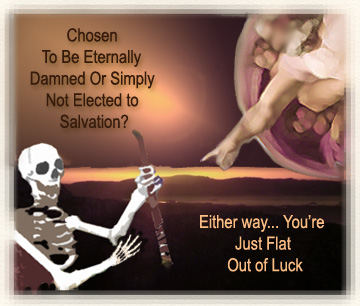
http://www.inplainsite.org/assets/images/Predestination.jpg
Believe it or not, the internet abounds with anti-Calvinist memes and pictures like this one
In this post I'll be talking about the notion of double-predestination: that God elects some people to heaven, and some people to hell. We'll specifically be looking at it from the point of view that it is an attack on Calvinism, since Calvinists are often charged with holding this view. Perhaps a later post will go over why the idea is unbiblical.

This objection has several problems in common with the claim that  "Calvinists believe that babies go to hell," which we went over in a previous post:

First of all, it is an emotional attack, meant to discredit rather than to disprove the Doctrines of Grace. It makes you go "Whoa, Calvinists believe that? I don't want to have anything to do with Calvinism!" Instead of pointing to scripture and saying "Here's how Calvinism is unbiblical, and therefore, wrong." This is a problem for those pushing this particular objection.

Secondly, it once again unfairly paints all Calvinists with the same brush. Yes, some Calvinists do believe in double-predestination (if I'm not mistaken, my old pastor in Florida is among them), but some don't (such as my family and many others). This is because...

Thirdly, the doctrine of double-predestination is NOT a specifically Calvinistic idea. Like last time, when we see a claim such as "X Calvinist believes X doctrine" we need to ask ourselves if X doctrine really comes from TULIP or from somewhere else. Double-predestination is not found in TULIP, though it can be made to fit with it.

Those are the three flaws that this argument shares with the last one (Calvinists hate babies), and I will not go into them in any more detail here since I already did there.

On to the argument itself. As is the case with many objections to Calvinism, the claim that Calvinism teaches double-predestination stems from misunderstanding. In this case, a misunderstanding of the Calvinistic Doctrine of Unconditional Election, as well as a misunderstanding of how God judges man.

The doctrine of Unconditional Election does not teach that God elects some people to hell and some people to heaven. UE deals specifically with God Electing people to Salvation, not Damnation.

But some would argue that God not electing people to heaven is basically the same as God electing those people to hell, and that on Judgement day, the condemned sinner cold use the excuse "But God, you didn't elect me!" But that's just not how it works.

God does not predestine people to hell. People destine themselves to hell by sinning. We had our chance in the garden, and we screwed up (Genesis 3). Adam's fall brought sin into the world, and all men, being descendants of Adam, are part of that sin (Romans 5:12). The wages of sin is death (romans 6:23), and thus, ALL men are condemned to Hell, not by any of God's doing, but by Adam's and by their own.

As for the "you didn't elect me" excuse, the reason it fails is that it misunderstands how judgement and atonement works. On Judgement day, God won't choose who goes to heaven and who goes to hell based on whether a person has been elected or not. Revelation 20:12-13 says:
"And I saw the dead, small and great, standing before God, and books were opened. And another book was opened, which is the Book of Life. And the dead were judged according to their works, by the things which were written in the books. The sea gave up the dead who were in it, and Death and Hades delivered up the dead who were in them. And they were judged, each one according to his works." (Emphasis mine)
It is our works by which we will be judged and condemned. And if that's the case, then we all deserve to go to hell because we're all sinners. This is where election comes in. I like the way the Baptist Catechism puts it:
Question 24: Did God leave all mankind to perish in the condition of sin and misery?

Answer: God, out of his mere good pleasure, from all eternity, having chosen a people to everlasting life, did enter into a covenant of grace, to deliver them out of the condition of sin and misery, and to bring them into a condition of salvation, by a Redeemer. (Ephesians 1:3-4; 2 Thessalonians 2:13; Romans 5:21; 8:29-30; 9:11-12; 11:5-7; Acts 13:48; Jeremiah 31:33)
So let's look at that non-elect sinner's excuse in light of what we know about judgment day. Yes, it is true that God didn't elect the person, but they couldn't use that as an excuse to get out of the punishment of hell. Why? Because they sinned, and the wages of sin is death.

As for the elect person, he has sinned too, and so is condemned to hell as well... BUT! "Moreover whom He predestined, these He also called; whom He called, these He also justified..." Because Jesus took their sin and punishment upon Himself, the elect man has been Justified.
"...and whom He justified, these He also glorified." (Romans 8:30, emphasis mine) Such will be the case for all of God's elect on Judgement day, and I hope by His Grace that you are among them, dear reader.

Tuesday, July 9, 2013

Calvinists Hate Babies?

http://cdn.memegenerator.net/instances/400x/33433764.jpg
I can't believe this meme even exists.
Ahhh, now that I've graduated, I have more time to spend blogging. This means that all of my blogs (which have gotten a little stale) will enjoy constant updates from now on.

One thing that I've read recently about blogging (and writing in general) is that if you don't know what to write about, find something that you're passionate about, that you get worked up over, and write about that.  So before I jump back into the numerous blog series I've left hanging (this and this), that's what I'll be doing. Posting about things that, for lack of a better expression, get my blood up.

Most will probably have to do with objections to Calvinism. I usually don't get emotional or worked up about most arguments, but some of the "arguments" against Calvinism are just so outrageous (like Irresistible Grace being "spiritual Rape"), that I think you'll understand my position.

So today I'd like to dive into one of the more emotionally-charged claims that is often leveled at the proponents of the Doctrines of Grace.

Here it is: "Calvinists believe that babies go to hell" Just hearing it makes me angry. However, I'll do my best not to let my emotions take control. Speaking of emotions, this argument is what's called an emotional attack, which, if you didn't know, is a fallacy (a mistake in logic or thinking).
The argument fails to disprove any one of the five points of Calvinism, but rather, it serves to discredit Calvinism and those who hold to it. Instead of using scripture to try to show us that Calvinism is unbibical, it uses our emotions to turn us against Calvinism.  Doesn't sound very Christ-like, does it?

But let's deal with the claim.  Do Calvinists believe that babies go to hell? The answer is that some do, some don't, and some aren't sure!  If you listen to John MacArthur's (a well-known Calvinist) sermon series on the "Campaign for Immorality" (which deals with Homosexuality and Abortion) we see that he believes that babies go to heaven if they die. However, there are Calvinists that do believe that babies go to hell when they die. But then there are also Calvinists, like Stephen Gambill, who believe that we can't know for sure where a baby's soul goes when it dies. Then there are some Calvinists who believe that some babies go to hell and others go to heaven.

What should this tell us?  It tells us, first of all, that NOT all Calvinists believe babies go to hell, and thus that the argument is false, but it also reveals another fallacy in the argument. The fallacy of composition, or the "Part-to-whole" fallacy, which basically goes "Some Calvinists believe babies go to hell, therefore, all Calvinists believe babies go to hell." Another mistake in logic, and not the last. Moving on...

I don't know how many times I've heard the claim "Calvinist X believes in weird doctrine X!" but the main problem with that claim is the main problem with this one. The question that needs to be asked dealing with this claim is this: "Does weird doctrine X flow from Calvinism, or somewhere else?"

Let me give an example. R.C. Sproul is a Calvinist, but he's also a Presbyterian. As we know, Presbyterians believe in infant baptism, and so does R.C. Sproul. Now I'm  Baptist, and disagree with Dr. Sproul on the issue of infant baptism.  So I could look at R.C. Sproul and say "Hey, R.C. is a Calvinist, and he believes in infant baptism! Calvinists must believe in infant baptism!" and now all my baptist friends and I are backing away from Calvinism. But let's ask that question: "Does R.C. Sproul's believe in Infant baptism flow from his belief in Calvinism?" the answer is no, it flows from the fact that he's a Presbyterian.

So when we hear that "X Calvinist believes that babies go to hell" what question should we ask? "Does X Calvinist's belief that babies go to hell flow from his belief in the Doctrines of Grace?" The answer will most likely be "No," and upon closer examination, we would probably find that such a belief comes from somewhere else in X Calvinist's worldview.

So we've looked over the three major logical problems with this argument. First, it's an emotional attack, and does nothing to disprove Calvinism. Second, it's a faulty generalization/blanket statement, saying that ALL Calvinists agree on something which they clearly don't; and thirdly, it assumes that just because a Calvinist believes babies go to hell means that the believe that because they're a Calvinist (when the belief very well could come from somewhere else).

"Okay, so not all Calvinists believe babies go to hell. But what if they're just being logically inconsistent? What if Calvinism teaches that babies go to hell, but those people are just ignoring it?"

Now we're getting somewhere! The argument has changed from "Calvinists believe babies go to hell" to "Calvinism teaches that babies go to hell." Most of the fallacious content has been removed, but the argument still has problems. Let's take it head on.

Nowhere in the five points of Calvinism (the Doctrines of Grace) will you find anything about babies going to hell. The fact is, Calvinism doesn't specifically say where babies go when they die. That's why we have Calvinists who do not agree on the whole issue. Only when Calvinism is combined with other outside beliefs do we get a verdict on where babies go when they die.

But, for the sake of discussion, let's say that Calvinism does teach that babies go to hell when they die. Now, let me ask a seemingly heartless question: What's wrong with babies going to hell when they die? I know! I sound like such a bad guy, don't I? But let's answer the question. What's wrong with babies going to hell when they die?

"Isn't it obvious?" we cry. "Babies are so helpless and cute and fragile and innocent, a loving God would never let them go to hell!"

But where's the logic? More importantly, where's the scripture? All I see is emotions. Now I probably sound really heartless.

The truth is, bad things happen. Things that we don't want to happen.Things that we have a hard time believing a loving God would allow. Tsunamis, earthquakes, hurricanes, tornadoes, and other natural disasters kill millions of people.  Serial killers, murderers, and evil dictators kill millions more.  Does God intervene? Not always. He allows us to suffer the curse of sin we've brought upon ourselves by disobedience to Him.  Why would God let babies go to hell, you ask?  For the same reason He lets anything bad happen: our sin. The real question we should ask is, why shouldn't God send everyone--not just babies--to hell, because of sin?

If you've read this far, I highly admire you. You've most likely read through some stuff you disagree with, and you probably don't have a very good opinion of me right now. Which is why I think it's high time that I shared my stance on this issue.

What's my stance? Do babies go to heaven or hell when they die? My answer is that I do not know. The truth is, I love babies. A lot. I want to have as many babies as I can when I'm married, and when I can't have any more, I'll try to adopt some. I really wish my family could have another baby around the house right now, because I love babies so much.

Obviously, my emotions lie with babies. But my emotions don't decide truth. Scripture, on the other hand, does. And what do I see when I look at scripture?
I see verses which tell us that all of mankind, which include babies, is sinful (Romans 3:23). I see verses that tell us we are sinners from birth (Psalm 51:5). I see verses that tell us that the wages of sin is death (Romans 6:23). Putting two and two together will get me four. However, there are other verses such as Matthew 18:3 which make it seem like babies are innocent. There's also 2 Samuel 12:21-23, which suggests that David's dead son by Bathsheba went to heaven.
So in my opinion, it could go one way or another. My emotions tell me that babies who die do not go to heaven, but I think there is insufficient scripture to prove or disprove such a belief. 

In conclusion: Do babies go to heaven when they die, or to hell? Do some go to hell and some to heaven? The Bible doesn't clearly say so. And since the five points of Calvinism are built upon the Bible, they don't say so either. Therefore, we would be wrong to say that "Calvinism teaches that all babies who die go to hell," or to claim that all Calvinists cling to such a notion.